


A well-insulated hot tub costs between €30 and €50 per month in electricity - roughly €1 to €1.70 per day. That is significantly less than most people expect, and far less than a swimming pool or even a daily coffee habit. The biggest factor in running costs is not the spa itself, but the quality of insulation and how consistently you use the cover.
In this guide, we break down every cost component: electricity, water care, filters, and the technology that makes the difference between an efficient spa and an energy drain.
Hot tub running costs average €30-50/month in electricity for a well-insulated spa. The heater accounts for 80% of energy use. A good cover, triple-layer insulation, and energy recovery technology like Hybrid Heating reduce costs by 20-30%. Annual maintenance (chemicals, filters, water changes) adds €150-300. Total cost of ownership: roughly €500-900 per year.
Electricity costs: what actually drives your energy bill
The heater is responsible for roughly 80% of a hot tub's electricity consumption. Its job is to maintain the water at your set temperature (typically 37-38°C) despite heat loss through the shell, cover, and surface evaporation. The remaining 20% goes to the circulation pump (which runs continuously for filtration), the jet pumps (which only run during use), and lighting.
This means that anything you do to reduce heat loss has a direct, measurable impact on your electricity bill. The three biggest factors are the cover, the insulation, and the ambient temperature. A well-fitted, thick cover prevents the majority of heat loss. Triple-layer polyurethane foam insulation in the shell retains heat far more effectively than single-layer or spray-on alternatives. And obviously, running costs are higher in January than in July.
How much does a hot tub cost to run per month?
For a quality spa with proper insulation, expect €30-40/month in summer and €40-60/month in winter. On an annual basis, that works out to roughly €400-600 per year. Budget spas with thin insulation and poor covers can cost twice that. The difference over a 10-year lifespan is significant - potentially €3,000-5,000 in extra electricity costs for a cheaper spa that seemed like a bargain at purchase.
How Hybrid Heating reduces your running costs
Most hot tubs rely entirely on an electric heater to warm the water. Passion Spas developed Hybrid Heating to supplement that heater with a second heat source: friction. The circulation pump agitates water molecules as it pushes water through the system, and that friction generates heat. In a conventional spa, this heat is wasted. Hybrid Heating captures it and transfers it to the water.
The result is a measurable reduction in how often the electric heater needs to run. Combined with triple-layer PU-foam insulation and a programmable control system that lets you schedule heating cycles around off-peak electricity rates, Passion Spas are engineered to minimize running costs without compromising water temperature. The low-wattage dedicated filtration pump further reduces consumption by filtering the water independently of the high-power jet pumps.
| Cost component | Annual estimate | How to reduce it |
|---|---|---|
| Electricity (heating) | €350-500 | Cover use, insulation, Hybrid Heating |
| Electricity (pumps/lights) | €50-100 | Low-wattage filtration pump, LED lighting |
| Water care products | €100-200 | Synergy system reduces chemical need |
| Replacement filters | €50-100 | Regular cleaning extends filter life |
| Water (refills) | €20-40 | Change every 3-4 months, not monthly |
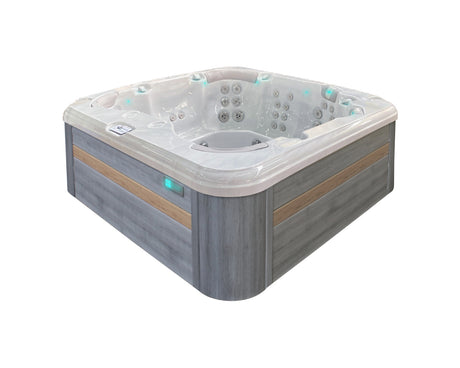
Resettle - Pure Collection
5-person spa with Hybrid Heating, 100% dedicated filtration, and ozone sanitization. Triple-layer insulation for minimal energy loss.
View spaWater care and maintenance costs
Beyond electricity, the ongoing costs of a hot tub are modest. Water care products - sanitizers (chlorine, bromine, or ozone-assisted alternatives), pH balancers, and occasional shock treatments - cost €100-200 per year depending on how much your spa's built-in systems handle automatically.
Passion Spas are equipped with the Synergy Water Maintenance System, which combines 100% dedicated filtration, ozone sanitization, and (in the Signature and Exclusive collections) UV purification. This triple-layer approach keeps the water cleaner for longer, which means you use fewer chemicals and change the water less frequently. Most owners change the water every 3-4 months rather than monthly.
Are hot tubs expensive to maintain?
Not if you choose the right spa. Replacement filters cost €50-100 per year (one to two replacements). Water itself is negligible - a full refill is a few euros. The real "hidden cost" that catches people off guard is energy waste from poor insulation and outdated heating systems. That is a cost you pay every month for the life of the spa, and it is entirely avoidable by choosing a well-engineered model upfront.
Reducing costs without reducing enjoyment
The most effective cost reduction is also the simplest: use the cover every time you leave the spa. A quality thermal cover prevents 60-70% of heat loss. Beyond that, keep your filters clean (a clogged filter forces the pump to work harder), maintain your water chemistry (poor chemistry degrades components faster), and use the programmable timer to heat during off-peak hours if your electricity tariff supports it.
One thing you should not do: lower the temperature dramatically when you are not using the spa for a day or two. Reheating from a cold start uses more energy than maintaining a steady temperature. For absences longer than a week, lowering by 3-5 degrees makes sense. For daily or every-other-day use, keep it at your preferred temperature and let the insulation do its job.
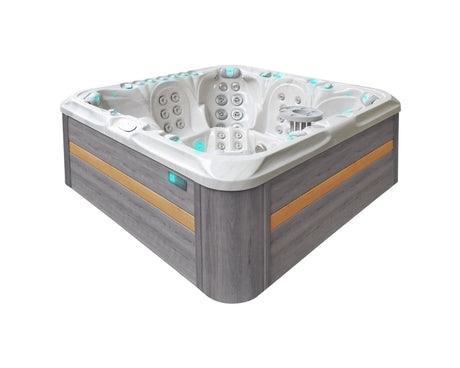
Excite - Exclusive Collection
7-person spa with full Synergy Water Purification (ozone + UV + filtration), Hybrid Heating, and every Passion Spas massage technology.
View spaFrequently asked questions
How much does a hot tub cost to run per month?
€30-50/month for a well-insulated spa, with winter months at the higher end. Annual electricity costs are typically €400-600. Spas with Hybrid Heating and triple-layer insulation sit at the lower end of this range.
What uses the most electricity in a hot tub?
The heater accounts for roughly 80% of energy consumption. The most effective way to reduce heating costs is consistent cover use, quality insulation, and heat recovery technology. The circulation pump, jet pumps, and lighting make up the remaining 20%.
Are hot tubs expensive to maintain?
Annual maintenance costs are €150-300 beyond electricity: water care products (€100-200), replacement filters (€50-100), and water for refills (€20-40). Spas with advanced purification systems like Synergy reduce chemical costs significantly.
How can I reduce my hot tub electricity costs?
Use the cover consistently (prevents 60-70% of heat loss), maintain clean filters, use the programmable timer for off-peak heating, and choose a spa with Hybrid Heating and triple-layer insulation. Do not lower the temperature for short absences - maintaining is more efficient than reheating.
Find a spa engineered for efficiency
Every Passion Spa features Hybrid Heating and dedicated filtration. Explore the collections and find the model that fits your space.


