


The features that matter most in a hot tub are not the ones most manufacturers advertise. The number of jets, the colour of the LED lights, and the Bluetooth speaker system get the headlines, but the features that determine your daily experience - and your running costs for the next 10 to 15 years - are insulation, jet placement, filtration, and build quality. Those are the areas where a well-engineered spa separates itself from the rest.
This guide covers the features that genuinely impact your ownership experience, ranked by importance, with the questions to ask before you buy.
The most important hot tub features in 2026 are energy-efficient insulation (determines running costs), physiotherapist-designed jet placement (determines massage quality), a dedicated filtration pump (determines water clarity), and multi-layer water purification (determines maintenance effort). Entertainment features are secondary. Focus on the engineering, not the marketing.
Energy efficiency: the feature that pays for itself
Insulation is the single most important feature in a hot tub because it affects your running costs every day for the life of the spa. The difference between a well-insulated and a poorly insulated spa is €300-400 per year in electricity. Over a 15-year lifespan, that is €4,500-6,000 - often more than the price difference between the two spas at purchase.
What to look for: triple-layer polyurethane foam insulation in the shell, a thick thermal cover with a tight seal, and a heat recovery system. Passion Spas uses Hybrid Heating, which recaptures friction heat generated by the circulation pump - energy that conventional spas simply waste. Combined with programmable controls that schedule heating cycles around your usage patterns, these features keep the heater from running unnecessarily.
What is the most important feature in a hot tub?
Insulation and energy efficiency, without question. Every other feature is something you experience during a 20-minute session. Energy efficiency is something you pay for (or save on) 24 hours a day, 365 days a year, whether you are in the spa or not. It is the foundation of good hot tub engineering, and it should be the first thing you evaluate - not the last.
Jet placement and massage quality
This is where many buyers get misled. A spa advertising "100 jets" sounds impressive, but the number of jets means nothing without adequate pump power behind them and intelligent placement. Forty well-positioned jets powered by properly sized pumps will deliver a vastly superior massage to 100 jets running on an underpowered system. More jets on a weak pump means each individual jet delivers less pressure - you end up with a gentle tingle instead of a therapeutic massage.
What separates a good jet layout from a great one is the involvement of physiotherapists in the design process. Passion Spas developed their massage systems in collaboration with physiotherapists, which is why the jets target soft tissue and tendons rather than bones - the same principle a trained therapist uses. The result is a range of proprietary massage technologies that each address a specific therapeutic need.
How many jets should a good hot tub have?
Focus on placement and variety, not quantity. A spa should offer different jet types (pulsating, rotational, directional) positioned to target major muscle groups: lower back, shoulders, calves, and feet. Adjustable intensity is essential so you can dial the pressure up or down to your preference. And critically, the jets should be backed by pumps with enough power to deliver real therapeutic pressure to every seat simultaneously.
| Feature | Why it matters | What to look for |
|---|---|---|
| Insulation | Determines running costs | Triple-layer PU foam, heat recovery |
| Jet placement | Determines massage quality | Physiotherapist-designed, soft tissue targeting |
| Dedicated filtration | Determines water clarity | Separate low-wattage pump, runs 24/7 |
| Water purification | Determines maintenance effort | Ozone + UV + filtration combined |
| Ergonomic seating | Determines comfort | Lumbar support, varied seat depths |
| Build quality | Determines lifespan | Hand-laminated shell, treated frame |
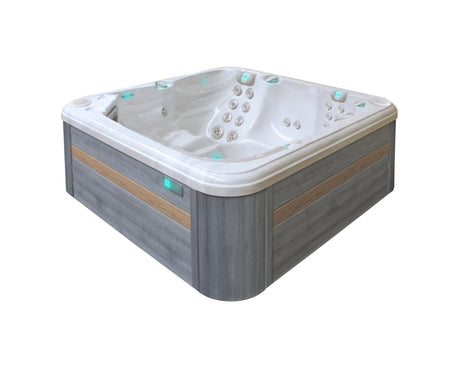
Reflect - Pure Collection
5-person spa demonstrating the fundamentals: Lumbar Support in every seat, Soft Tissue Massage jets, dedicated filtration, ozone purification, and Hybrid Heating. No unnecessary complexity.
View spaFiltration and water purification: less maintenance, cleaner water
A dedicated filtration pump is one of the most underrated features in a hot tub. Many spas filter the water only when the jet pumps are running. That means if you use the spa for 30 minutes a day, the water is only being filtered for 30 minutes a day. A dedicated filtration pump runs continuously at low wattage, independent of the massage jets, ensuring your water is filtered 24/7.
On top of filtration, the method of water sanitization makes a significant difference in maintenance effort. Basic systems rely on manual chlorine dosing. Better systems add ozone, which oxidizes contaminants automatically. The best systems combine ozone with UV purification and 100% dedicated filtration - Passion Spas calls this the Synergy Water Maintenance System, available in the Signature and Exclusive collections. The practical impact: cleaner water with less effort, fewer chemicals, and longer intervals between water changes.
Seating comfort and build quality
You will sit in your spa for 15-30 minutes at a time, often daily. The two things to evaluate: lumbar support (does the seat support your lower back's natural curve?) and seat variety (different depths for different body types). Passion Spas builds Lumbar Support into every seat across all collections.
Build quality determines lifespan. Look for a hand-laminated acrylic shell, a pressure-treated support structure, and maintenance-free panels. These are not visible features, but they are the reason some spas last 15-20 years while others deteriorate after 5. Ask to see the underside at the showroom - a confident manufacturer will show you.
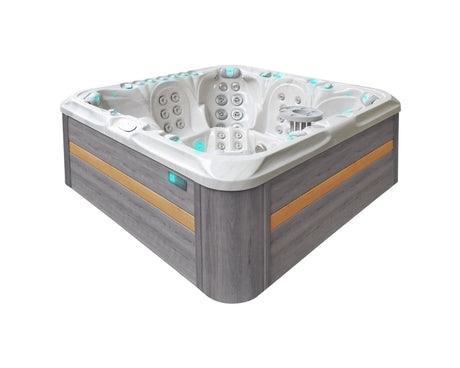
Excite - Exclusive Collection
The complete package: Aqua Rolling Massage, Levitation Bed, Waterfall Massage, Therapy Wave Zone, full Synergy purification, Hybrid Heating, and integrated audio. 7 persons, 7 seats.
View spaFrequently asked questions
What is the most important feature in a hot tub?
Insulation and energy efficiency. It determines your running costs for 10-15 years. A well-insulated spa with heat recovery saves €300-400/year versus a poorly insulated one. Over the lifespan of the spa, that difference exceeds most purchase price gaps.
How many jets should a good hot tub have?
The number is less important than placement, variety, and pump power. 40 well-positioned jets on strong pumps outperform 100 jets on weak pumps. Look for physiotherapist-designed placement on soft tissue, adjustable intensity, and multiple jet types. Explore Passion Spas massage technologies for examples.
What should I look for in a hot tub in 2026?
In order of priority: 1) Insulation quality and energy efficiency, 2) Jet placement designed with physiotherapists, 3) Dedicated filtration pump, 4) Multi-layer water purification, 5) Ergonomic seating with lumbar support. Entertainment features are a bonus, not a priority.
Is a dedicated filtration pump important?
Yes. It filters water 24/7 at low wattage, independent of the massage jets. Without one, water is only filtered when jets run. This means cleaner water, lower chemical costs, and more efficient heating. All Passion Spas include dedicated filtration as standard.
See the features that matter in person
Visit a Passion Spas dealer to compare collections, test the massage technologies, and inspect the build quality up close.


